

Thunderbird Chief AI Officer Program

Get Your Brochure
Overview
The Thunderbird Chief AI Officer Program prepares senior executives to lead enterprise AI transformation with global strategic clarity. Drawing on Thunderbird's unmatched expertise in global leadership, ranked No. 3 in U.S. custom executive education by the Financial Times 2026, this program equips leaders with the frameworks, technical fluency, and organizational capabilities to architect, champion, and govern AI initiatives that deliver measurable value.
Across 16 live interactive sessions over six months, participants build their AI Global Transformation Playbook, which is a rigorous, actionable strategy document developed iteratively across all four modules, reviewed at the program midpoint, and presented to lead faculty in the final session.
Start Date
05 January 2027
Duration
6 months
Fee
USD 6,400
Program Highlights
- 2-Day In-person Campus Immersion

- 16 live interactive sessions led by Thunderbird faculty

- 6-month executive learning journey focused on enterprise AI transformation

- AI Global Transformation Playbook developed iteratively over working labs

- Certificate from Thunderbird School of Global Management, Arizona State University

- Peer coaching and assessments

- Small cohort for learning impact

Curriculum
Build a rigorous AI strategy that positions your organization to win, identifying where AI creates durable advantage, where it threatens existing business models, and how to sequence transformation for maximum impact.
Mapping the AI Opportunity Stack: Where Value Is Created and Destroyed
Apply a structured framework to map AI opportunities across the full value chain, from productivity and cost reduction to new revenue streams and business model reinvention.
Distinguish short-term quick wins from medium-term transformation and long-term strategic repositioning, sequence initiatives for impact and organizational readiness.
Participants select their organization or industry and begin scoping their AI Global Transformation Playbook.
Competitive AI Strategy: Offense, Defense, and Disruption Response
Identify where AI-native competitors threaten your core business and where you hold defensible moats, applying a structured disruption-response framework across industries and geographies.
Determine when to build, partner, acquire, or retreat in the face of AI challengers; map competitive AI dynamics in your sector.
AI Business Models: New Products, Ecosystems, and Value Architecture
Explore how AI enables fundamentally new business models, platform economics, AI-as-a-service, data network effects, and intelligent product layers across global markets.
Redesign pricing structures, incentive models, and value chain relationships for the AI era; build a business model canvas for an AI-first version of your organization.
Making the AI Investment Case: ROI Frameworks and Financial Governance
Construct rigorous AI investment cases using ROI frameworks, risk-adjusted returns, and stage-gate governance structures that give organizations confidence to commit capital at scale.
Understand how AI investments are evaluated differently from traditional technology spending and how to position AI initiatives within existing capital allocation processes.
Build a rigorous AI strategy that positions your organization to win, identifying where AI creates durable advantage, where it threatens existing business models, and how to sequence transformation for maximum impact.
Mapping the AI Opportunity Stack: Where Value Is Created and Destroyed
Apply a structured framework to map AI opportunities across the full value chain, from productivity and cost reduction to new revenue streams and business model reinvention.
Distinguish short-term quick wins from medium-term transformation and long-term strategic repositioning, sequence initiatives for impact and organizational readiness.
Participants select their organization or industry and begin scoping their AI Global Transformation Playbook.
Competitive AI Strategy: Offense, Defense, and Disruption Response
Identify where AI-native competitors threaten your core business and where you hold defensible moats, applying a structured disruption-response framework across industries and geographies.
Determine when to build, partner, acquire, or retreat in the face of AI challengers; map competitive AI dynamics in your sector.
AI Business Models: New Products, Ecosystems, and Value Architecture
Explore how AI enables fundamentally new business models, platform economics, AI-as-a-service, data network effects, and intelligent product layers across global markets.
Redesign pricing structures, incentive models, and value chain relationships for the AI era; build a business model canvas for an AI-first version of your organization.
Making the AI Investment Case: ROI Frameworks and Financial Governance
Construct rigorous AI investment cases using ROI frameworks, risk-adjusted returns, and stage-gate governance structures that give organizations confidence to commit capital at scale.
Understand how AI investments are evaluated differently from traditional technology spending and how to position AI initiatives within existing capital allocation processes.
Develop the technical fluency a CAIO needs to evaluate AI systems, interrogate vendors, govern deployments, and lead technical teams with credibility. Grounded in real enterprise applications.
How Modern AI Systems Actually Work: A Leader's Technical Primer
Develop a working understanding of how today's AI systems are built, including foundation models, large language models, fine-tuning, retrieval-augmented generation (RAG), and agentic architectures, at the level a CAIO needs to ask the right questions of technical teams and vendors.
Understand AI system limitations, failure modes, hallucinations, bias, and cost structures, the technical realities that determine whether an AI deployment succeeds or fails at scale.
Learn to evaluate vendor claims, assess build-vs-buy decisions, and interrogate technical proposals with confidence.
AI Infrastructure and Data Strategy: The Foundation of Enterprise AI
Understand the data architecture decisions that determine AI success, including data lakes, vector databases, data quality, governance pipelines, and the organizational challenge of making enterprise data AI-ready.
Assess cloud AI infrastructure options, on-premise vs. hybrid deployments, and the cost, latency, and data sovereignty tradeoffs that shape enterprise AI architecture choices across global operating environments.
Apply a data readiness diagnostic to your organization: what needs to be in place before AI can deliver value at scale.
Agentic AI and Automation: Enterprise Applications and Deployment Realities
Examine the shift from generative AI tools to agentic AI systems, including AI that plans, executes multi-step tasks, and operates across enterprise workflows — and what this means for process redesign, risk, and human oversight.
Explore live enterprise deployments of agentic AI in operations, finance, supply chain, customer service, and software development, examining what is working, at what scale, and under what governance conditions.
Build a framework for evaluating which enterprise processes are ready for agentic AI versus those requiring deeper human oversight and intervention design.
AI Disruption in Practice: Panel with Technology Leaders
Faculty-moderated panel with technology executives from AI-native companies, global enterprises, and the venture ecosystem to discuss the real frontiers of AI disruption.
Discussion themes: Where enterprise AI is delivering transformational value today; the biggest organizational and technical barriers to scale; what the CAIO role looks like from the inside; and where AI is headed in the next 18–36 months.
AI Risk, Ethics, and Governance in Practice
Build a comprehensive AI risk framework, covering technical failure, regulatory exposure, reputational risk, ethical harm, and competitive obsolescence, with contingency protocols for high-stakes AI failures in complex global operating environments.
Navigate the evolving global AI regulatory landscape, including EU AI Act, US federal and state frameworks, sector-specific regulation, and translate compliance requirements into practical governance architectures that scale across jurisdictions.
Examine case studies of AI governance failures and the organizational design lessons they reveal for CAIOs building enterprise-wide accountability structures.
Designing the AI Initiative Portfolio: Experimentation, Sequencing, and Scale
Architect a balanced portfolio of AI initiatives spanning quick wins, transformation bets, and long-horizon experiments, sequenced for organizational readiness, resource availability, and strategic priority.
Build a stage-gated experimentation and scaling framework: how to run low-cost AI experiments, capture learning, make kill-or-scale decisions, and move from pilot to enterprise deployment without losing momentum.
Apply technical evaluation criteria to initiative prioritization: data readiness, integration complexity, vendor dependency, and total cost of deployment at scale.
Build the leadership capabilities that distinguish a CAIO from an AI expert — driving transformation through people, culture, and organizational systems across geographies and cultural contexts.
The CAIO Role: Mandate, Operating Model, and Organizational Design
Define the CAIO mandate, including scope of authority, reporting structure, and key interfaces with the CEO, CTO, CDO, CIO, and the wider leadership team; benchmark against emerging CAIO archetypes across US, European, and Asia-Pacific organizations.
Design AI operating models: centralized center of excellence, federated, embedded, or hybrid — and when each is right for your organization's culture, scale, and AI maturity stage.
Leading AI Transformation Across Cultures and Geographies
Apply Thunderbird's global leadership frameworks to AI adoption across different cultural contexts, diagnosing and overcoming resistance, trust deficits, and adoption barriers in globally distributed enterprises.
Examine how leading multinationals navigate AI transformation across diverse workforce cultures, regulatory environments, and digital maturity levels across the US, Europe, Asia, and emerging markets.
Rewiring Work: Automation, Augmentation, and the AI-Transformed Workforce
Redesign jobs, workflows, and team structures for an AI-augmented workforce, building a strategic augmentation architecture that captures AI value without eroding employee trust and organizational capability.
Build an AI talent strategy: Attracting AI-literate senior leaders, reskilling existing teams, and creating a culture of continuous AI learning that sustains transformation momentum over time.
Change Management and Stakeholder Strategy for Enterprise AI Transformation
Apply proven change management frameworks to the specific challenges of enterprise AI adoption, managing resistance, building internal coalitions, and creating durable organizational readiness for continuous AI evolution.
Develop a stakeholder engagement strategy: from frontline employees and middle management to government partners, regulators, and external partners across global operating contexts.
AI Disruption in Practice: Panel with Technology Leaders — Moderated by Faculty
Faculty-moderated panel bringing together 3–4 senior technology executives from AI-nativecompanies, global enterprises, and the venture ecosystem to discuss the real frontiers of AI disruption.
Discussion themes: where enterprise AI is delivering transformational value today; the biggest organizational and technical barriers to scale; what the CAIO role looks like from the inside; and where AI is headed in the next 18–36 months.
Live Q&A with the cohort — participants bring their toughest strategic and technical questions to practitioners shaping the AI landscape.
Format: 90-minute panel. Panelists drawn from Thunderbird's global corporate network and XED's practitioner community. Faculty moderates; cohort submits questions in advance
Throughout the program, each participant develops a rigorous, actionable AI Global Transformation Playbook. This is a strategic document built iteratively, stress-tested with peers and faculty at the mid-program review and completed for final presentation in Session 16. The Playbook covers:
A global AI opportunity and threat assessment: short, medium, and long-term, contextualized for the participant's organization or industry.
A prioritized portfolio of offensive and defensive AI initiatives, sequenced by value and organizational feasibility.
A stage-gated experimentation and governance framework to derisk and scale AI deployments.
An organizational architecture, operating model, team design, and talent strategy, to execute the transformation.
A cross-cultural change management and stakeholder engagement plan.
Working Labs
Participants will develop and refine their AI Global Transformation Playbook with industry experts through three focused small-group working labs designed to sharpen their assumptions, surface strategic blind spots and strengthen the coherence and credibility of their Playbook.
AI Global Transformation Playbook Report Out
Select participants present their completed AI Global Transformation Playbook to the faculty and cohort covering the full arc from opportunity assessment and competitive strategy to initiative portfolio, governance architecture, change management plan, and risk framework.
DAY 1 : From AI Strategy to Enterprise Execution | Los Angeles Capstone
Session 1: Defining the Chief AI Officer Mandate
Topics covered: The evolving role of the Chief AI Officer; scope of authority; reporting relationships; decision rights; and collaboration with the CEO, CIO, CTO, CDO, CHRO, business-unit leaders, and board.
Activity: CAIO Mandate Workshop — Participants define the purpose, responsibilities, organizational interfaces, decision authority, and success measures of the CAIO role within their organizations.
Key takeaway: Participants develop a clear and credible CAIO mandate aligned with their organization’s strategy, AI maturity, governance requirements, and leadership expectations.
Session 2: Leading the AI-Transformed Organization
Topics covered: Workforce augmentation; job and workflow redesign; organizational culture; employee trust; talent development; stakeholder engagement; change leadership; and adoption across business units, functions, and geographies.
Activity: AI Transformation Leadership Workshop — Participants identify critical stakeholder groups, likely sources of resistance, required leadership actions, communication priorities, and organizational capabilities needed to accelerate adoption.
Key takeaway: Participants develop a human-centered leadership approach for creating confidence, capability, and sustained organizational commitment to AI transformation.
DAY 2 : Governing AI and Leading Enterprise Transformation | Los Angeles Capstone
Session 1: Responsible AI Governance in Practice
Topics covered: Enterprise AI governance; executive accountability; human oversight; ethical risk; regulatory exposure; data protection; intellectual property; cybersecurity; reputational risk; and third-party AI providers.
Activity: AI Governance Architecture Workshop — Participants design a practical governance model defining decision rights, approval processes, oversight responsibilities, escalation pathways, risk controls, and executive accountability.
Key takeaway: Participants build a governance architecture that enables responsible AI innovation while protecting the organization from legal, ethical, operational, and reputational risks.
Session 2: Leading the AI-Transformed Organization
Topics covered: Workforce augmentation; job and workflow redesign; organizational culture; employee trust; talent development; stakeholder engagement; change leadership; and adoption across business units, functions, and geographies.
Activity: AI Transformation Leadership Workshop — Participants identify critical stakeholder groups, likely sources of resistance, required leadership actions, communication priorities, and organizational capabilities needed to accelerate adoption.
Key takeaway: Participants develop a human-centered leadership approach for creating confidence, capability, and sustained organizational commitment to AI transformation.
Please note that in the event of a global or regional catastrophe, or any unforeseen circumstances, the program's schedule, delivery method, faculty, and associated elements are subject to change at the sole discretion of the university.
Indicative Faculty

Tom Hunsaker
Tom Hunsaker | Thunderbird School of Global Management
Read More

Ziru Li
Asst. Professor of Global Transformation Thunderbird School of Global Management at Arizona State University
Read More

Anjelina Belakovskaia
Associate Teaching Professor in Global Finance | Thunderbird School of Global Management at Arizona State University
Read More

George Runger
Professor, School of Computing and Augmented Intelligence Arizona State University
Read More

Stephanie Forrest
Center Director and Regents Professor, Biodesign Center for Biocomputing, Security and Society Arizona State University
Read More

Euvin Naidoo
Distinguished Professor of Practice in Global Accounting, Risk and Agility Thunderbird School of Global Management at Arizona State University
Read More
Sample Certificate
Participants who successfully complete the Thunderbird Chief AI Officer Program will be awarded a Certificate from Thunderbird School of Global Management at Arizona State University
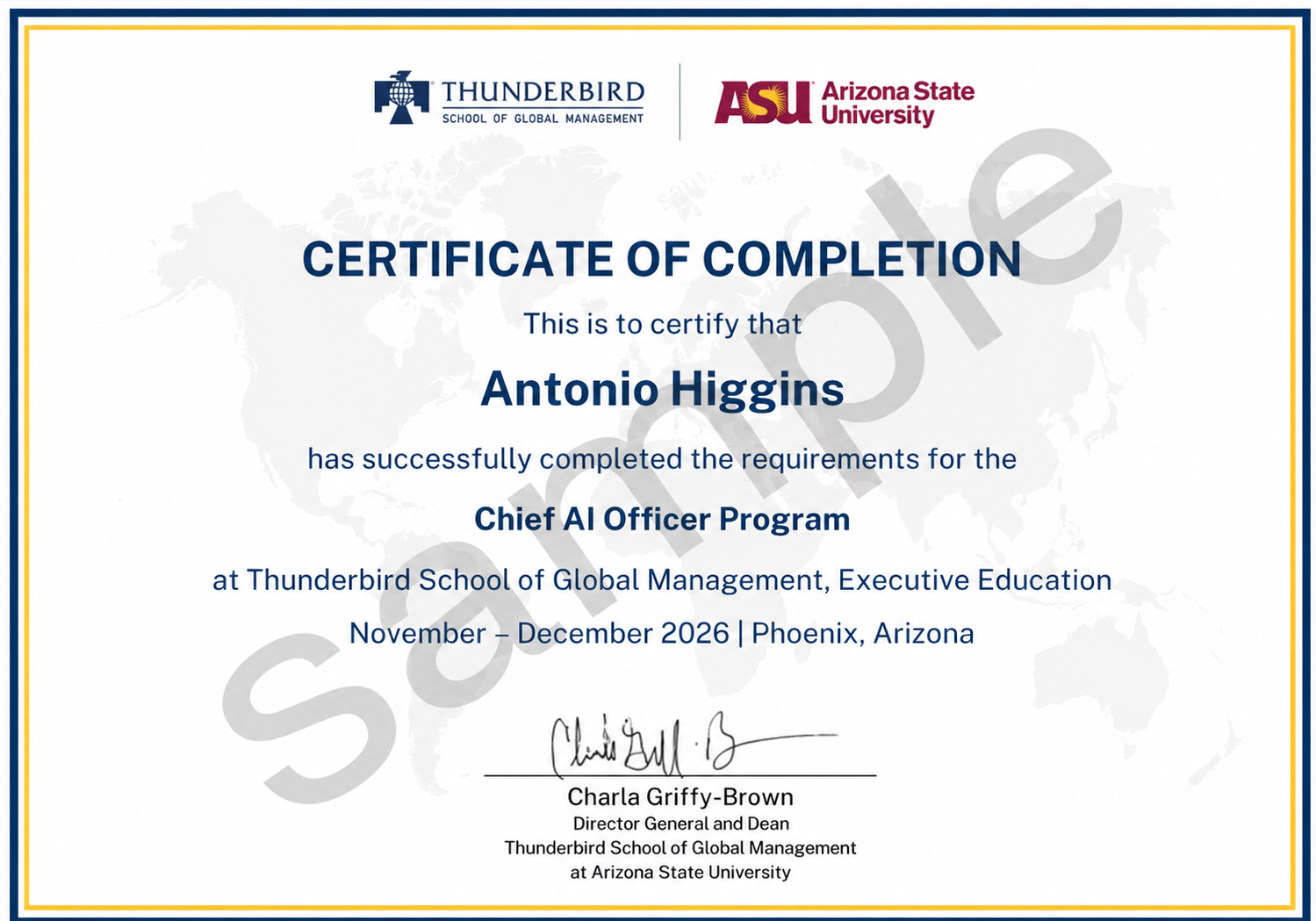
Note: Certificate image is for illustrative purposes only and may be subject to change at the discretion of the university.
Who Should Apply
The Thunderbird Chief AI Officer Program is designed for current and emerging CXOs, senior executives, and global leaders across industries who want to lead AI transformation and not just understand it.
Current roles including CEO, COO, CTO, CDO, CIO, CHRO, Chief Strategy Officer, Managing Director, SVP, or VP of Innovation.
Leaders operating across geographies, markets, or cultures — or those with responsibility for international business units.
No technical AI background required.
PREREQUISITES:
10+ years of experience in senior leadership roles, with a track record of leading complex, cross-functional initiatives.
At least an undergraduate degree or equivalent professional qualification